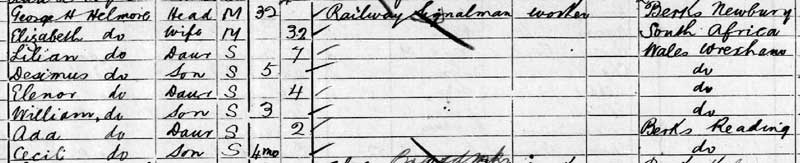
1900 Nov 29 Born. St Bartholomews, Reading, Berks
1901 census at 73, Rupert Street, Reading St Giles
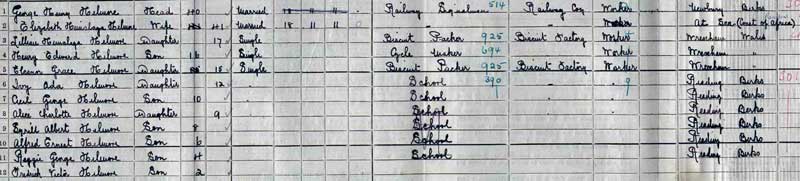
1911 census at 23 Kings Road Caversham
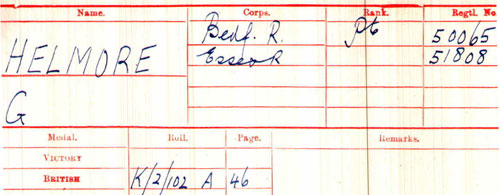
There is the possibility, no stronger than that , that Helmore was in Beds & the Essex Regt for a short period before he joined the Marines. I was trying to establish where Johnson could ever have been Helmore's CO and this is the only possibility. But it turns out that it could not be the same man as Pte. G. Helmore, 50065 Bedford R., 51808 Essex R. was George Helmore, born 1895, enlisted 10 November 1917. Parts of his damaged service record survive . His address, on one of the forms, was given as 94, Invicta Road, Sheerness. Another paper, a confession, states that he served in 19th Bn. the Essex R. and goes on to state that he had absented himself from that unit on 20 August 1919 and fraudulently enlisted in the regular forces as L/12673 1st Bn. The Buffs on 31 August 1919 at Canterbury.
1918 Oct 29 Enlisted in Royal Marines. His service record shows that he was a railway porter before he enlisted. Next of kin is his father Harry Helmore, 23 Kings Rd, Caversham, Reading. At Deal recruit depot. He was paid a war gratuity of £5
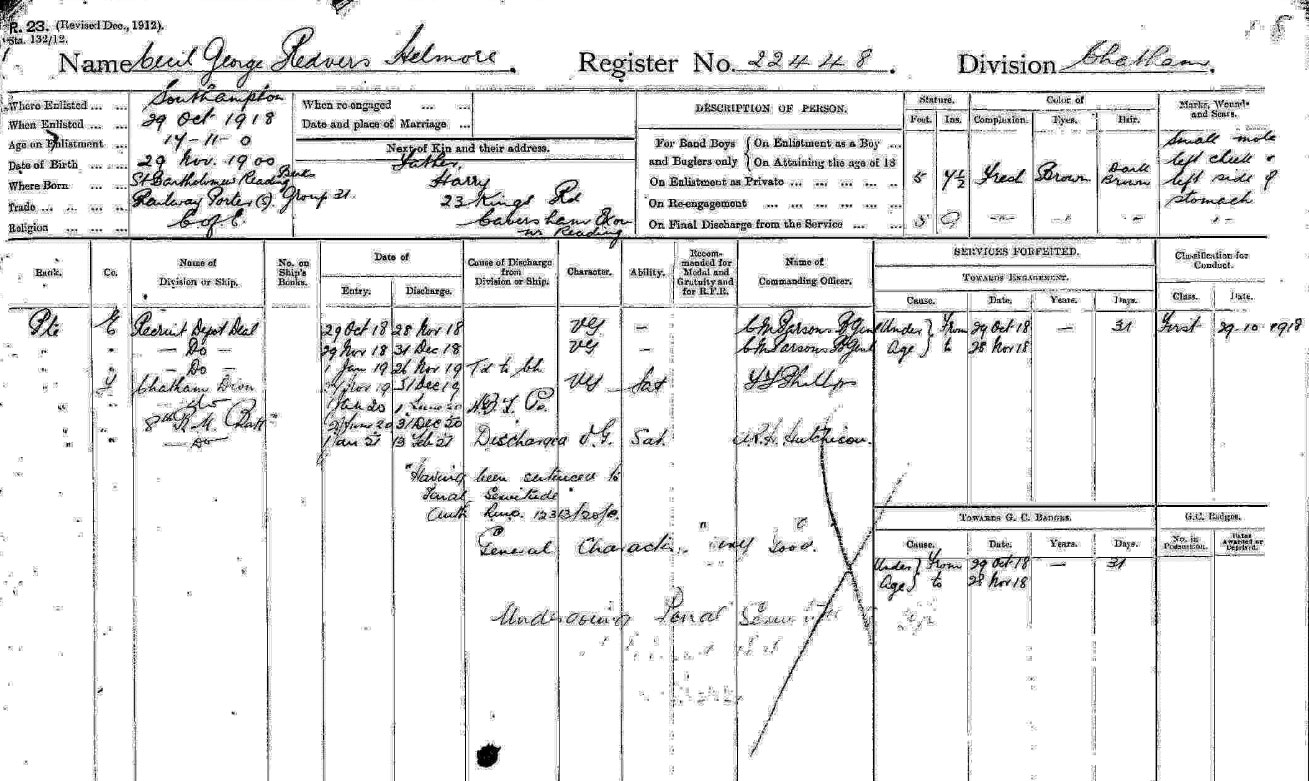
1919 Nov 27. Posted to Chatham
1920 Jun 2. Posted to 8th RM Battalion
1921 Feb 13. Discharged. "Having been sentenced to penal servitude" for the murder of Cpl Charles Cleaver Yates at Ballyvaughan Coastguard Station. Oram and PutKowski's ' Death Sentences passed by military courts of the British Army' gives Pte CGR Helmore of Royal Marine LI was sentenced to death 11th February 1921 for murder, commuted to Penal Servitude for life.
The Court Martial is in NTA at WO 71/1414
He is noted as a convict in Maidstone Prison
1921 Aug . A letter arrived at the Admiralty from a London law firm: R Voss & Son asking for copies of the court martial paperwork. They had been instructed by a Lieutenant-Colonel Walter Russell Johnson to look at the case again and make sure that all the facts had been considered. The reason given by Voss & Co was that Helmore had served under him and was well known to him. However, there is no evidence of this. Helmore was 13 when the war broke out, so it is unlikely that he joined the army in the period between August 1914 and October 1918 when he joined the Marines.
From Nicola Hallam Hallam Johnson said he had received a letter from Helmore in 1920 with a full statement of events and he had advised him to tell the Prisoner's Friend (the officer appointed to defend him) so that the facts could be laid before the court. Johnson heard nothing more and assumed all was well. It was only when he returned to England that he found out the result of the trial from Helmore’s parents. They had spent a great deal of their savings in their efforts to help their son but with the arrival of Lt Col Johnson they decided to leave it in his hands. Voss said Lt Col Johnson was anxious to help due to his personal knowledge of the prisoner and his excellence of character. Johnson visited Helmore in Maidstone Prison and realised that the court had not heard the true facts behind the case.
In October 1921 Voss & Son provided the Admiralty with Helmore's full statement. There were several points they wanted to bring to the attention of the Admiralty:
In his statement Helmore told how he first met Yates when the 8th RM battalion was formed in May 1920 and they became friendly. About a fortnight after arriving in Ireland Yates started to talk to Helmore about a "certain topic" and Helmore found his suggestions and overtures repulsive. He refused to have anything to do with him. Yates however was persistent, telling Helmore that he wanted him more than he wanted anybody before and that he had always been able to get a good time onboard ship. He pestered Helmore for days. Eventually Helmore gave in and so they went for a "stroll in the village and several times in the country after - I had never done this before". A short time afterwards Helmore said that he realised that what he was doing was wrong and resolved to have nothing more to do with Yates. Yates did not take this well and continued to suggest a walk to Helmore right up to 3 days before the shooting. On this occasion when Helmore refused and tried to leave the room Yates took hold of him and there was a struggle, furniture was overturned, some of the other men came down to see what all the trouble was but neither Helmore nor Yates would say. After this he felt that some of the other men were a bit aloof with him. Also he felt that Yates picked on him, giving him more than his share of work and calling him a fool in front of another marine. On the day of the shooting Helmore described going down to the village for supplies with another man and having a few drinks. On getting back to the station Helmore says he sat in his room and realised what a dreadful thing it was that had happened between himself and Yates and that he was 'completely ruined'. He wished to be free of him. His revolver was on the bedstead. Of the event itself he remembered standing in the doorway and then being on the floor. He remembered being charged with shooting with intent to kill and attempted suicide. He said that he wrote to his commanding officer to ask about Yates was but did not find out he had died until much later.
Voss & Co then called the Admiralty to ask permission to question another messmate of Helmore's called Smith that Lt Col Johnson had tracked down. On 8th September, Voss wrote to the Admiralty with Smith’s statement. J W Smith was a reluctant witness but a key one. He stated that he first met Yates in Leicester in 1919, they met up a few times after that casually and did not meet again until they were both at Chatham. He describes seeing Yates and Helmore frequently talking together sitting on Helmore's bed when they were in Chatham. He said that Yates did not associate with any other private in the way he did with Helmore. Other men noticed this as well and commented ‘here comes Yates with his winger’. He noticed that sometimes when Helmore and Yates were talking alone Helmore would blush. Once in Ireland he observed Yates and Helmore walking together. He was only based at the Coastguard Station in Ballyvaughn for a fortnight and left about a week before the shooting. When he heard about the shooting and it was said that Helmore and Yates had quarrelled about a girl he didn't believe it as neither of them, to his knowledge, went out with girls. He said it was only then he thought the friendship between Helmore and Yates was more than an ordinary friendship. This statement was a double-edged sword for Helmore’s case. It appeared to corroborate the story that Yates’ interest in Helmore was ‘unnatural’ and therefore confirmed the likelihood of there being sexual intimacy between the two but, as noted in a comment by the Royal Marines Adjutant, “assuming for the sake of argument that their relations were irregular at Chatham, this assumption tends to discredit the view that Helmore shot Yates owing to a sudden revulsion of feeling”. Voss wanted to know whether the Admiralty would follow up with Smith but the Admiralty felt there was little point as it was not likely to be able to prove that Yates was the instigator or that his attentions were unwelcome. It was decided that Helmore’s sentence would be reviewed after he had served five years. Assuming good behaviour this meant he should have been released in around 1926. There is no note on the court martial paperwork to confirm the date he was eventually released.
1939 Register Living at The Wadfield , Cheltenham R.D., Gloucestershire. He is General Manager for a Theatrical Agent. In the same house is Anthony Leslie Smith, who in 1974 was living at Cameron House , Puckane with Helmore. And was also the Marine that made the statement about Helmore's homosexuality in the Marines in Ireland
The lady in the house, Diana Carter Campbell was born Diana Morrison Kirkwood in 1905 at Yeo Vale, Devon, England.2 She was the daughter of Major John Hendley Morrison Kirkwood and Gertrude Agnes Lyle.1 She married George Lorne Carter-Campbell, 6th of Possil, son of Arthur Campbell Carter-Campbell, 5th of Possil and Kathleen Isabelle Hilhouse, 7th of Possil, on 16 December 1925.1 She and George Lorne Carter-Campbell, 6th of Possil were divorced in 1926.1 She died on 10 February 1969.

1955 Jan 17 Leaves UK for Madeira on SS Venus
1956 Jan 16 Leaves UK for Madeira on SS Venus
1956 Feb 21. Arrives in UK from Madeira on SS Venus. Travels first class. He is single, retired and his address is given as Cameron House, Puckane, Nenagh, Tipperary. Anthony Leslie Smith is on same ship with same address
1958 Jan 18. Leaves UK for Madeira on SS Venus
1958 Feb 18. Arrives in UK on SS Venus.
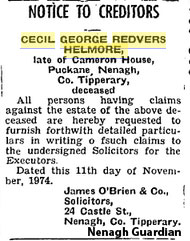
1974 Nov 7 Died at Nenagh , Tipperary. There is no documentary proof that explicitly proves they were in a relationship. There wouldn't be after all, same-sex sexuality was decriminalised in England and Wales in 1967 but it was 1993 before Ireland followed suit. When he died Helmore left everything to Smith.
 .
.